
In 1820, the spectacular Norwegian mountain Falketind was climbed for the first time. Explore how this iconic summit became the soul of Norrøna’s most popular collection.
“ARE WE GOING UP THERE?”
The question hangs in the cold air above Falkbreen Glacier, right in the heart of Jotunheimen, Norway’s high mountain wilderness. It comes from a young woman leading a rope team. She’s pointing up a steep mountain wall made up of rock, snow, and moss.
“Are we really?”
The second question comes from another young woman – this one in the middle of the rope team. She’s pointing to the same dark face of rock.
I – their father – pretend to be a rugged mountain man, brimming with confidence and control. I say just one thing. I try to say it in a calm voice and with complete conviction. I say:
“Yes.”

NORWAY IS HOME TO A LONG LINE OF SPECTACULAR MOUNTAINS. Majestic peaks rising straight from the fjords, tall and proud, taking everything the weather can throw at them. The sharpest of these mountains we call “tinder” – peaks like needles trying to pierce the clouds and lure the sun out. Many of the tallest peaks are found inside and close to Jotunheimen National Park – a wilderness area the size of a small state.
Just outside the borders of this great park, where the terrain drops down to the narrow innermost arm of the Sognefjord, you’ll find a summit like no other. It’s named after a bird of prey – one of the most skilled fliers in the world.
The mountain has inspired artists, climbers, and adventurers for more than 200 years. And there are really no easy ways up. If you want to reach the summit, you have to put in the work. You’ll need to leave your fear of heights behind – once and for all.
Prepare for a long day surrounded by rock, snow, ice, and nothingness.
The best time to attempt the climb is from July to September. Later in the fall, the days get shorter and Falkbreen Glacier becomes even more shattered by deep, dangerous crevasses. In winter and spring, almost no one reaches the summit – due to avalanche danger and general inaccessibility.

BUT LET’S TURN BACK THE CLOCK 205 YEARS. On July 14, 1820, three young men stepped out onto this very glacier. They were technically collecting plants and rock samples for scientific research, but now they stood here, at the glacier, staring up at a mountain more beautiful and more unapproachable than anything they had seen before. The three men deserve a brief introduction:
- Christian Peder Bianco Boeck, 22 years old, with an above-average interest in botany, later a physician and professor of physiology.
- Baltazar Mathias Keilhau, 23, son of a parish priest, would later become the first person in Norway to earn a degree in mineralogy, and, like his good friend Christian, went on to become a university professor – not in physiology, but in geology. In 1844, he attempted to climb Norway’s highest mountain, Galdhøpiggen, but only reached the fore summit, which was named after him and still bears the name Keilhaus topp (“Keilhaus´ Summit).
- Ole Urdi, age unknown, a local reindeer hunter and mountain guide from the nearby village of Øystre Slidre – no middle name, no university credits, but probably the strongest and most mountain-savvy of the three.
BOECK, KEILHAU, AND URDI stood on the Falketind Glacier and considered whether to continue toward the summit. It looked steep. Terrifyingly steep.
For some reason, they decided to go for it.
They were brave. They wanted to reach the top. They wanted to be the first.
Keilhau later described the climb like this:
“Small creeks trickled down everywhere from the snow overhangs above. The water ran down our arms each time we grabbed a protruding rock or crack to pull ourselves up. I would not be far wrong to say that the route upon which we climbed in the Feldspathgangen Divide was 800 feet straight up from the glacier. After one, through great risk, is done moving from the solid mountain over the overhanging snow mass, the route up the back side of Falketind is no longer dangerous. The summit is only a few steps wide, and has an extremely torn up appearance. It is hard to find solid rock, and the highest point looks like a random pile of stone.”
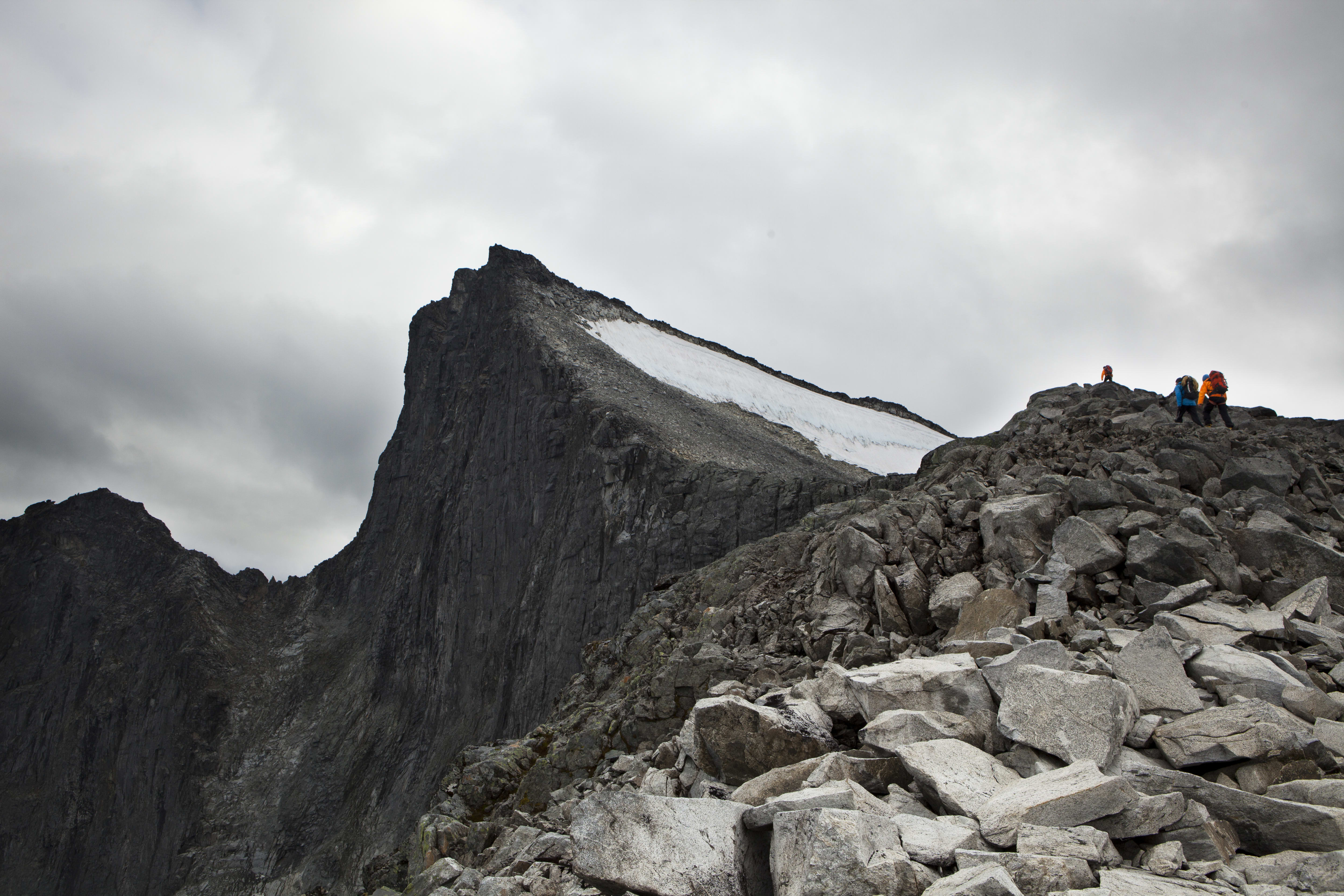
THE THREE MEN MADE IT TO THE SUMMIT. Fifty-six years before the British climber William Cecil Slingsby made the first ascent of the famous Store Skagastølstind summit, these three young amateurs conquered one of the most alpine peaks in Scandinavia.
It was a truly unmatched achievement in Norwegian mountaineering history. A climb that, in many ways, has received far too little recognition.
Books should be written about it.
Podcasts should be made.
Films produced.
And clothing lines produced.
AND HERE WE ARE, at least, a father with his two daughters, standing on a narrow mountain ledge high above Falkbreen Glacier, following in the footsteps of the first ascenders, along the climbing route that would later be named “The Pioneers’ Route”.
The climbing isn’t difficult. It doesn’t require superhuman ballet moves, you don’t need to climb indoors three times a week to come here, and you don’t need to be a Himalayan climber.
Some even solo the route – without ropes or protection.
I’ve done it myself – in my youth (as the saying goes).
But the exposure is serious enough that most people choose to go as a rope team, with a climbing rope, cams, nuts, and slings.
That’s what we’re doing now.
You simply can’t fall here.
A fall could end very badly.
And a father on a trip with his daughters doesn’t want anything in the world to go wrong.
WE MOVE SLOWLY, STEADILY, AND SAFELY from ledge to ledge on the sheer east face.
I set belay anchors at regular intervals – so we can communicate easily.
“Anchor!” I shout down toward the glacier, after securing myself to the rock.
“Got it!” my eldest daughter shouts back.
She removes me from her belay device and yells “Climb on!” up to me.
The Falketind summit rises into the sky to our left.
Much of Jotunheimen stretches out in front of our boot tips.
It was Boeck, Keilhau, and Urdi who came up with the idea of naming these mountains after the “jotner” – the giants of Norse mythology. That’s how the area got the name Jotun Mountains, inspired by the Riesengebirge (Giant Mountains) in what is now Poland and the Czech Republic.
The Norwegian poet and journalist Aasmund Olavsson Vinje later renamed the area Jotunheimen, or “Home of the Jotner.”

WE CLIMB OVER THE EDGE of the steep east wall and rest on Falketind’s ridge. We gaze down on the first ascent route, and are deeply impressed by what those young gentlemen managed to do 205 years ago.
What were they thinking when they realized they would actually make it?
What was going through their minds as they took these last steps to the summit?
Here, so close to the top, we truly get to experience the beauty of Falketind up close. And only now can we really speculate on the mountain’s name. Why was it named after the falcon, this bird of prey? Norway is home to several species of falcons – all extremely fast – that, if you’re lucky, you might spot and study with binoculars in the wild.
We have the gyrfalcon.
The peregrine falcon.
The merlin.
The kestrel.
And a few red-footed falcons.
Poet Aasmund Olavsson Vinje – the one who came up with the name Jotunheimen – was the first to call this mountain Falketind (“The Falcon Summit”), fifty years after the first ascent.
Before that, the mountain was mostly known as Koldetind.
Vinje reportedly wrote the following about his name choice:
“The black peak with its beak bent in a curve is like the falcon, swaying to take flight; a white patch on its breast is speckled in, and therefore it is called Falketind (“The Falcon Summit”).”
WE REACH FALKETIND’S MAIN SUMMIT early in the afternoon. The view is – to put it mildly – massive. In every direction.
There is Stølsnostind.
There is Koldedalstind.
There is Uranostind.
There are 3500 square kilometers of Jotunheimen.
My daughters walk to the edge of the drop. They lie on their stomachs and look straight down into the abyss.
They see two rope teams crossing the glacier far below us.
“People look so small down there,” says one of them.
“All people feel small up here,” says the other.
We all agree that it’s probably a good thing to feel this small from time to time.
FACTS ABOUT THE FALKETIND COLLECTION:
Behind the Seams
An alpine first ascent – decades before alpinism truly arrived in Norway. And, of course, the mountain’s striking shape. Falketind has inspired Norrøna in many different ways.
“Falketind was the first alpine peak climbed in Norway – all the way back in 1820”, says Jørgen Jørgensen, owner and leader of Norrøna.
“The mountain has an iconic shape – and a legendary place in Norwegian mountaineering history and in our poetry. And finally: Falketind lies at the heart of Norwegian “friluftsliv” – our famous outdoor lifestyle – in the great Jotunheimen mountain range. It was almost a given that we named an entire collection after this mountain.”
Norrøna launched the falketind collection back in 2003. Before that, Norrøna had a tent by the same name, but in 2003 Norrøna wanted to develop an entire collection.
“The idea was to create clothing and gear for mountaineering – with solid weather protection, light weight, and year-round usability”, Jørgen says.
“This was during a time when our Norrøna trollveggen jacket was very popular. It was super durable, but also quite heavy. Our ambition was to create something much lighter – but still durable.”
Norrøna falketind´s success became apparent quickly in the years that followed. Jørgen mentions that renowned climber and Norrøna ambassador Robert Caspersen wore falketind gear while climbing Gessnertind in Antarctica.
“We realized that we had created products light and functional enough for summer use in the mountains – but also protective enough for winter expeditions in Antarctica.”
Falketind is now Norrøna’s most popular and most-selling collection. It’s a line that works across all types of outdoor activities – from climbing and mountaineering to hiking and skiing.
“We’re proud of the versatility in this collection,” says Jørgen.
“You can buy a falketind Gore-Tex jacket that works for everything – and fits with everything. The design is clean and minimalist, so the products are easy to match with other gear.”
NEWS IN STORE:
The Brand New falketind Products
The Norrøna falketind collection is all about durable lightweight. For every season. And for all kinds of weather.
Norrøna has launched several new products and new styles in the falketind collection this spring. Here are a few of them:
FACTS ABOUT THE CLIMB:
Welcome to Falketind
Travel to the base of Falketind: About four-five hours by bus from the Norwegian cities of Oslo or Bergen to Tyinkrysset. From there, a roughly 30-minute bus ride to the staffed mountain lodges Tyinholmen Lodge or Fondsbu Lodge. By car, you can drive a rough, unpaved road from Tyinholmen all the way to the national park border at Koldedalen Valley.
Accommodation: Stay at the staffed mountain lodges Tyinholmen or Fondsbu – or in your own tent. Check out fondsbu.no, tyinholmen.no and dnt.no for more info.
The climb to the summit: We strongly recommend hiring a certified mountain guide for climbing Falketind. The route is demanding and requires local knowledge and experience with glacier travel and climbing. You can tailor your own trip to the summit via Norrøna Adventure. See adventure.norrona.com for more details.
If you stay at one of the staffed lodges, you can sign up for a guided tour of Falketind and have arranged motor vehicle transport to Koldedalen Valley. Alternatively, you can hike from Fondsbu or walk/bike along the dirt road to Koldedalen from Tyinholmen. If you're camping in Koldedalen, you’re already very close to the base of Falketind.
The “new normal route” to the summit is Pionerruta (“The Pioneers’ Route”), as described in the main story here. Again: we strongly recommend hiring a certified climbing guide to reach this summit. If you have the experience and knowledge to climb independently, it is highly recommended to bring a rope, ice axes, crampons, helmets, and various protection gear.
Important: The old normal route went through the Morka-Koldedalen Valley and then steeply up the mountainside above Andrevatnet Lake. However, in recent years, glacier and snow melt has made this area increasingly unstable with loose rocks and boulders. After several extremely dangerous incidents and near-accidents, this route is now closed.
Winter Ascent: Falketind sees very few visitors during the winter months. Not only is the approach long and demanding – the various routes to the summit are highly exposed to avalanches. In spring, however, it’s possible to climb the mountain from the “back side” when weather and snow conditions allow: by bike – with skis strapped to your pack – from Øvre Årdal and Hjelle up to the abandoned mountain farm at Vetti. From there, continue to the self-service cabin Vettismorki (run by the Norwegian Trekking Association). Then ski east and upward toward the Stølsnosi Ridge and then down and across the Stølsnosbreen Glacier to the summit of Falketind. We strongly recommend hiring a mountain guide, as the route requires local knowledge and experience with steep skiing, glacier travel, and climbing.
Other nearby peaks: Falketind’s proud neighbors – the Stølsnostind and Hjelledalstind summits – are both excellent destinations for alpine touring. We’ll soon be publishing dedicated articles about these mountains here on Norrøna’s blog. Other popular summits in the area include Uranostind, Slettmarkpiggen, Galdebergtind, and Mjølkedalstind.
More information: The Norwegian climbing guide "Klatrefører for Jotunheimen" (Norsk Tindeklub) or the hiking guide "Fotturer i Jotunheimen" (Iriss Forlag).